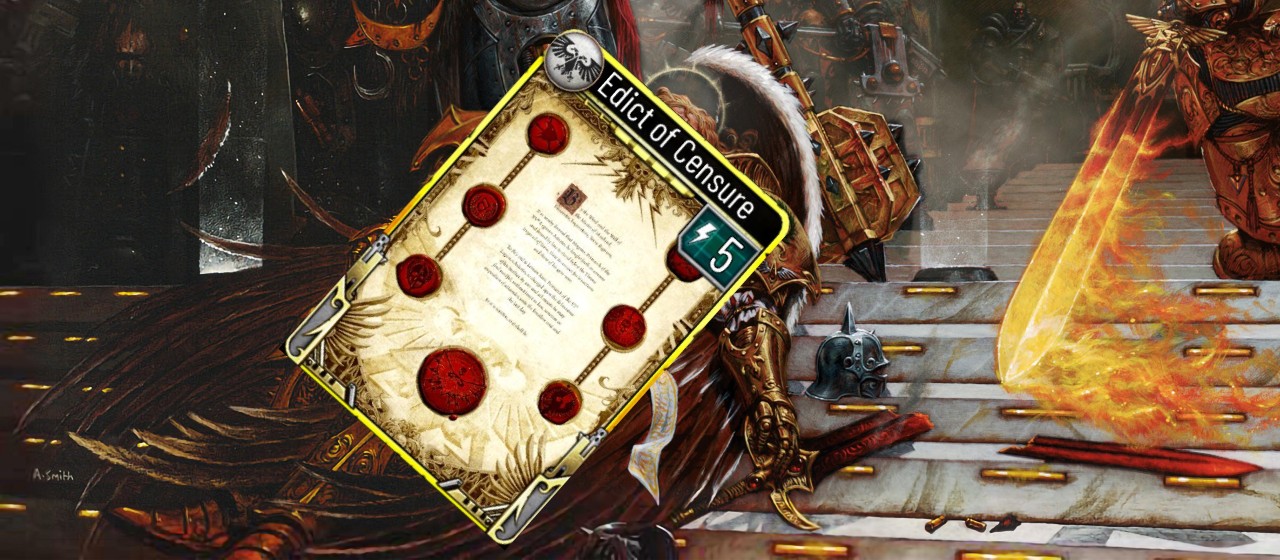
I wanted to write about the best card in the Horus Heresy: Legions CCG ever since it was removed from the game. Maybe even before then. But now, with the servers definitely shut down by the time this post goes live, it will serve as an epitaph for the whole game. So here’s my tribute to Edict of Censure and, at the same time, to Horus Heresy: Legions.
Explaining the Edict to the Imperial Citizen
Horus Heresy: Legions is played with 30-card decks centered around a Warlord. He (and it’s most often a he) has attack and health values just like any other troop, as well as one or more special abilities. The goal is to kill the enemy Warlord while protecting your own. Most other cards in the game are split between troops and tactics.
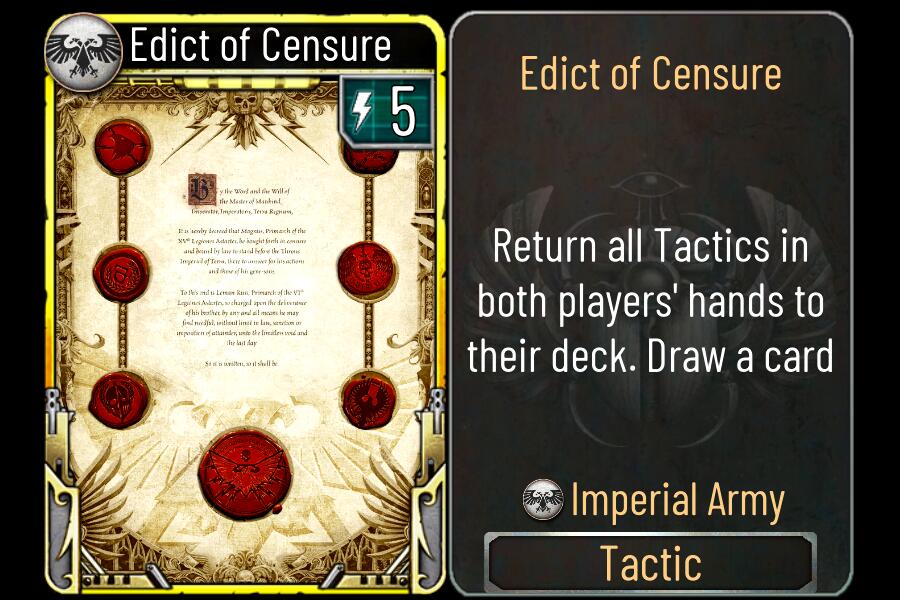
Edict of Censure is a simple card for a Legendary tactic. The former means that you only get one per deck (normal cards can be taken twice), the latter that its effect is immediate. When you play Edict of Censure, both players shuffle the tactics from their hands back into their decks.
Why is this important?
Like in Magic: The Gathering, troops can’t act on the turn they’re played/deployed. They have attack scores and health just like warlords, and can attack other units or play abilities (if they have them). Theoretically, they can stay on the field for a long time, dealing and soaking damage disproportionately to their cost.
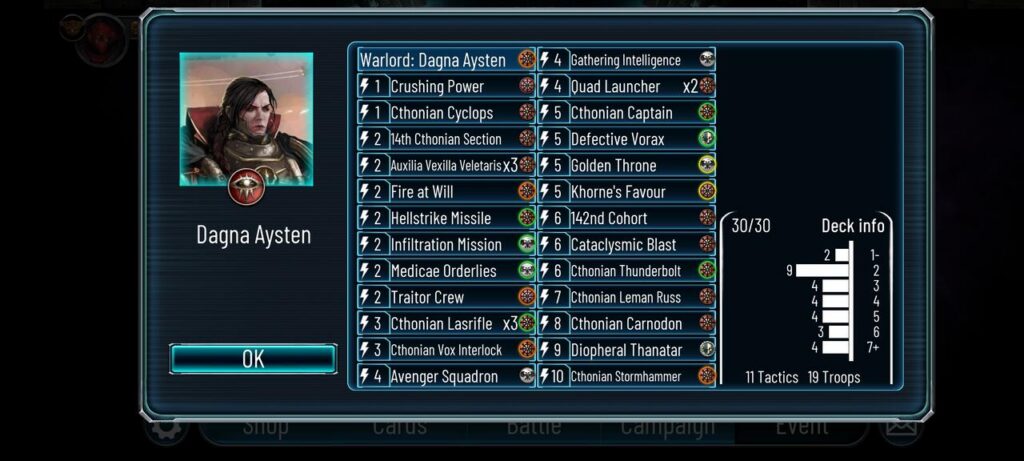
Meanwhile, tactics are one-shot, one-and-done deals. Many of them don’t even deal damage, instead boosting allies, debuffing enemies, drawing cards, and so on, into more esoteric effects. Sometimes, you can’t play them as there are no legal targets on the board.
However, tactics are played and resolved instantly.
A troop, after its played, has to survive until your next turn to do its thing. Until that point, it’s vulnerable to other troops and tactics. Meanwhile, there’s no way to prevent a tactic from being played.
On People Who Should Be Treated Like Erebus
I usually tried to have decks that had 20 troops and 10 tactics. I don’t know why I decided like that — maybe I read something at some point. I was never part of the community, so I never really knew anything about the meta, or any specialist lingo, or even memes.
I was in it for the Space Marines.
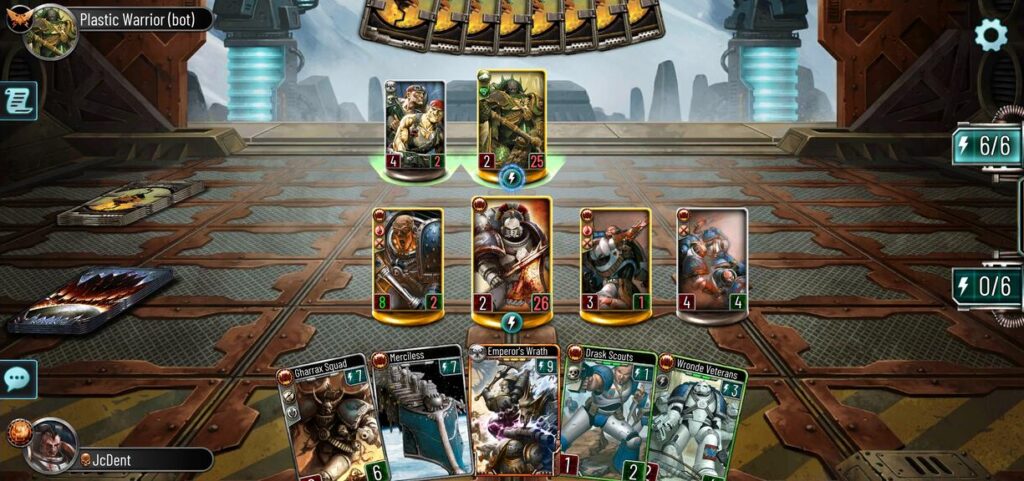
However, not everyone was, and a deck could be constructed entirely from tactics cards. Some Warlords actually supported — even encouraged — such an approach.
I called those people tactifuckers because as a newly 30-years-old, I had the insult sophistication level of a kindergartner.
Two of the most usual offenders were Angron players or anyone playing Alpha Legion. The former works thematically, as Agron was a raging asshole who never played with his sons. The latter was the Legion of choice for people that were rightfully neglected by their parents.
For Angron, tactics were focused on boosting and healing the angriest boy while also providing ways to destroy enemy troops without getting the Primarch involved. His, like any ideal tactifucker deck, would never let any troops activate.
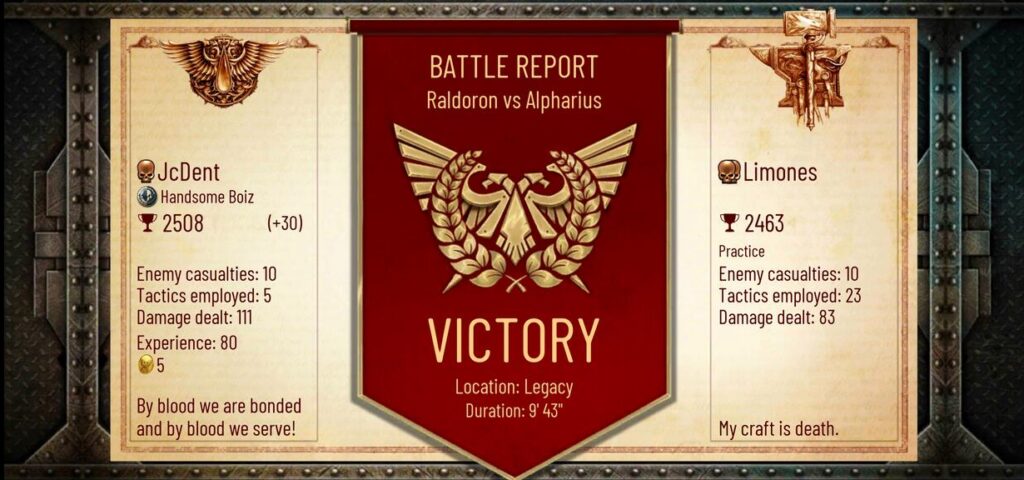
Alpha Legion, for no matter the Warlord, was meant for players who wanted to ignore the opponent entirely. It was built entirely on stuffing the enemy deck with Traps.
Traps were cards that, when drawn (usually automatically at the start of the turn) could would do one of the following:
- hurt the Warlord;
- destroy a random unit;
- stun the entire enemy team;
- draw three more cards.
Of course, drawing a card that not just fucked you, but also took the place of one of your cards would feel bad. That’s why after drawing a Trap, you’d draw again. There was nothing preventing you from drawing another Trap. You could cascade. You could cascade to the point where you exhausted your deck and died from draw-from-empty-deck damage.
The other Alpha Legion gimmick was Secret Orders. You could play them on enemy units to make them deal damage to the first friendly troop played, swap places when ordered to attack a unit, or attack their own Warlord when ordered to attack yours, and so on. You know, fun stuff. Mind games, which is one of the best aspects of any game.
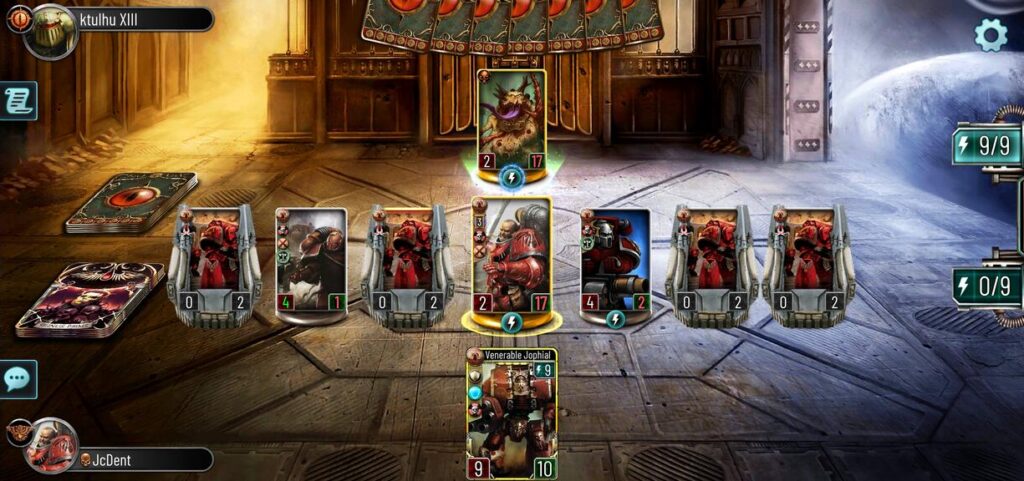
But this would give the enemy ways to out-think you. The enemy could deal with Orders by playing smart. Plus, the enemy may have been a tactifucker with no troops. For the kind of imitation human that played Alpha Legion, that was unbearable.
Playing against Alpha Legion was misery comparable to only to facing a 2-1 Grind-set Dwarf player in Blood Bowl or engaging with 40K rules.
Maybe I Should Have Given You Less Context
So, if tactics take effect immediately and you really have no defenses against them, what can you do? Well, the enemy can’t hurt you if you break their arms, and Tactics can’t be played if they’re back in the enemy deck.
Enter our beloved Edict of Censure. At five energy, it’s playable from the fourth turn. It shuffles all the tactics back into their respective decks. If the enemy had nothing but tactics, whelp! They’re left hoping that that the draw is one their side.
Meanwhile, you most likely still hold a few troops cards that you can play at your relative leisure, and then beat the tactifucker’s face in the way Alan Bligh intended: with the ceramite-armored fists of Space Marines.
Playing Edict of Censure and seeing the enemy hand go away is a great feeling. But what makes the card itself great is not, in absolutely any way, an I-WIN card:
- The odds of drawing it aren’t great and 5 energy is not a trivial price.
- If you drew it on turn 4 (when you first have 5 energy), it may be a suboptimal time to play by the virtue of the opponent not having that many cards in hand.
- It is very much a gamble when playing against people who aren’t tactifuckers. The opponent may end up not discarding any cards at all.
- In later turns, a non-tactifucker may have troops on the field that could get deadly if ignored in favor of playing Edict of Censure.
- At the same time, various Warlord-upgrading tactics are costed similarly to Edict and can be played before you get to do it.
- The Edict also affects you. So a tactifucker wouldn’t ever take it. But I, for one, played a Raldoron deck that had some very fun/important tactics to play, including Spear of Telesto, a 6 energy unit-destroying card that went down in price when your units died while it was in your hand. Shuffling it back in would reset the price. And that was just one of the Very Important Tactics in that deck.
Combined, the factors transforms Edict from an I-WIN into a WE CAN BOTH LOSE card. It is know that powerful options which can instantly, obviously, and catastrophically backfire are peak game design. That’s why overheating plasma guns and Perils of the Warp/Miscast are such good concepts.
There are I-WIN cards in the game, usually in the form of fat Legendaries dealing nearly ten damage and thus making for fast, inevitable endgames. Vengeful Spirit, in its last iteration, cost 8 and dealt 8 damage, wiping out a good chunk of health for anything. Shuffling them into the deck is very satisfying. Also very satisfying? Shuffling cards into the deck after the enemy has played an expensive card draw or creation card. It’s high risk-high reward griefing — the only ethical kind of griefing.
The Edict wasn’t the only WE CAN BOTH LOSE card in the game, but it was the best neutral one, meaning you could include it in any deck. Another favorite of mine was the Iron Warrior Viral Bombs:
Deals 2 damage to every unit on the field. If any unit dies, deals 1 damage to everyone. It could do so recursively. Outside of Warlords, there could be 12 units on the field at one time, and the easiest way to have many unit is usually by deploying trash. With 12 units, the math of who hits 1 HP in time to die and make the card procc again is hard, at least for me.
You just drop it and hope that it kills the enemy before it kills you. The game then hopefully becomes non-interactive for a minute or two as the chain reaction plays out.
Messing Things Up Even When You’re Not The Emperor Of Mankind
With Shadow of the Warmaster expansion in 2023 (and coinciding heavily with Horus Heresy 2E), Horus Heresy: Legions started refreshing the card collection and retiring the initial crop of cards. This spelled the end for a lot of fun cards like this.
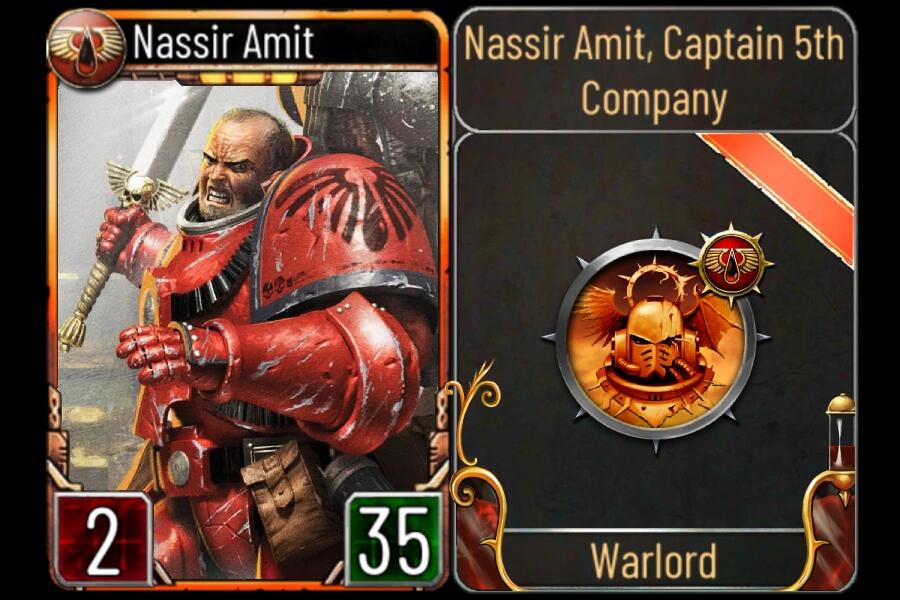
In the place of mechanics (and Warlords like Kharn and our precious boy Nassir Amit) that threatened you as well as the enemy came a deluge of powerful, unpreventable and non-interactive mechanics.
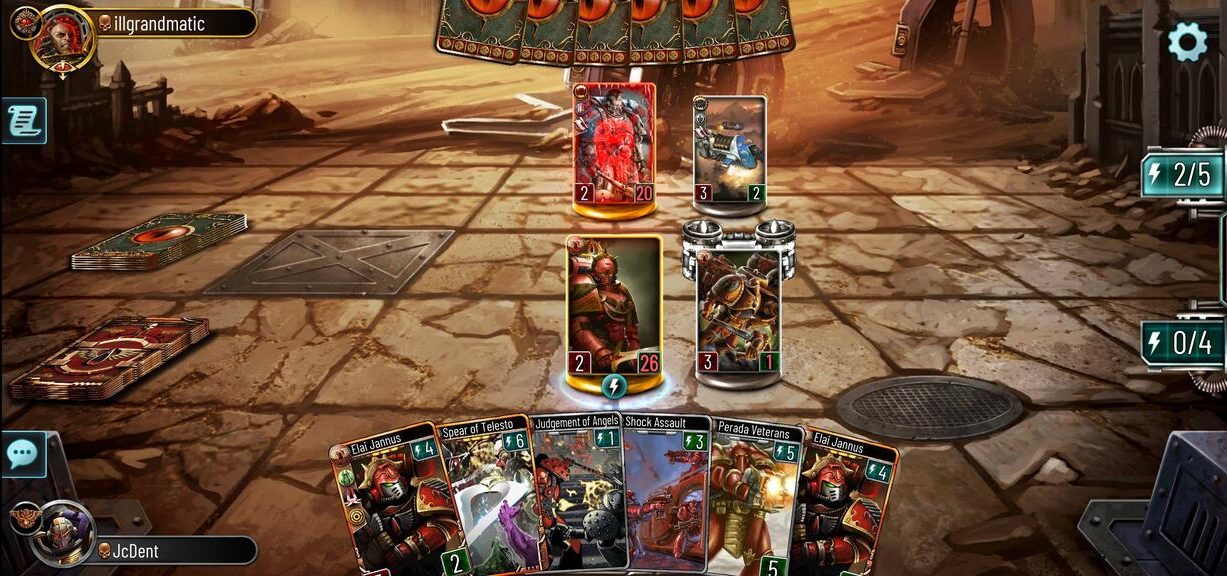
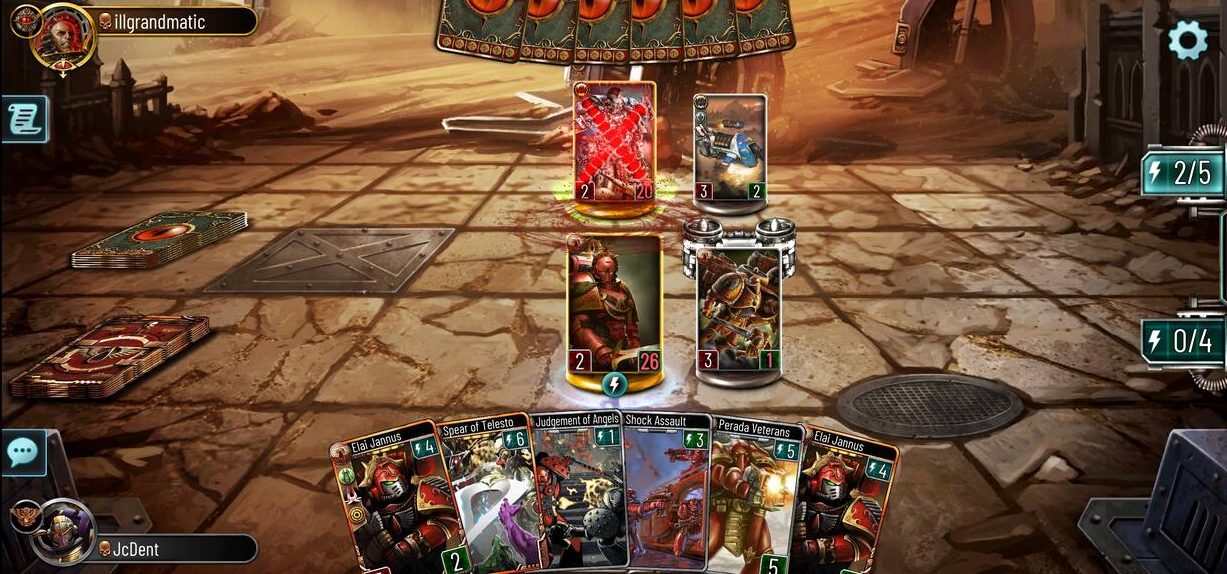
Not that this kind of faulty game design hadn’t been seen before.
Primarch-based Warlords had a transformation mechanic that would turn them into an upgraded version under certain, most often end of match conditions. Some of these required deft play and luck, like Angron being reduced to 1 health, or Leman Russ hitting 4 health at the same time as the enemy.
Others required absolutely no skill. Horus’ transformation cost would decrease when he played Chaos cards — that would force the player to have at least 10 of them in the deck. Luther, for example, would charge up his Arch-Traitor transformation by playing troops that had the Duplicitous skill. Since all the Duplicitous cards were in the Caliban collection, he simply had to tailor the deck somewhat. What could the opponent do to prevent that? Jack and also shit.
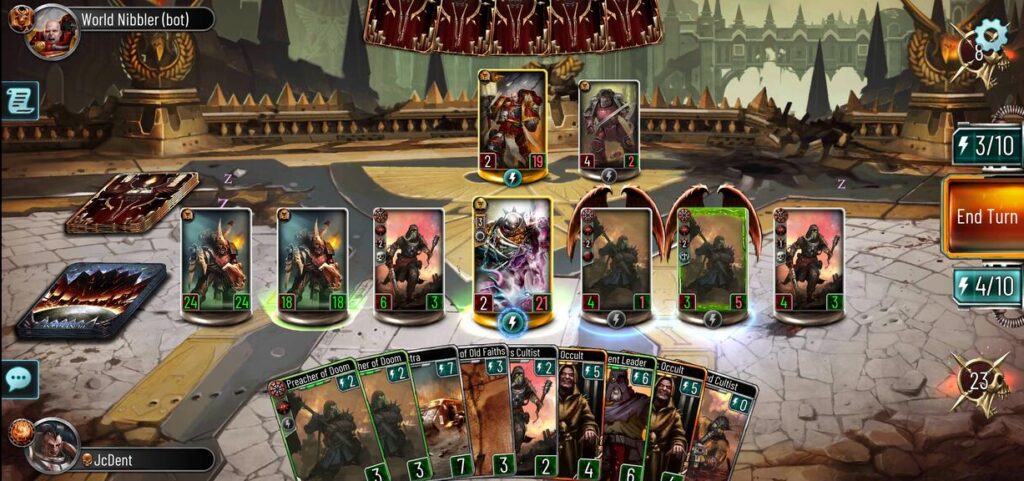
There was a lot more of this in Legions 2.0. Dark Angels could boost themselves endlessly while still in hand and/or deck. Knights and Thousand Sons had a separate energy pool to power their strongest abilities.
Fittingly, Imperial Fists became even more miserable to play against after revamp. Previously, they leaned hard on spawning endless waves of structures that dealt damage (rather than attack) automatically at the start or end of the turn. They could be boosted endlessly with Imperial Fists’ Bastion gimmick: HP that only counted in defense — on the attack, a unit with 1 HP and 10 Bastion was as doomed as a unit with just 1 HP.
Structures never attacked. They just sat there, automatically dealing damage to random targets.
It was already not fun to play against Fists pre-Shadow of the Warmaster — and the structure focus was so strong that trying to play without them didn’t feel like much fun either.
Revamped Imperial Fists took it a step further. Sure, Bastion and structures were still a big thing. But like all Legions post Shadow, Imperial Fists got a second gimmick. If Bastion was defensive HP, Sentry was defensive attack. Defensive attack that struct first.
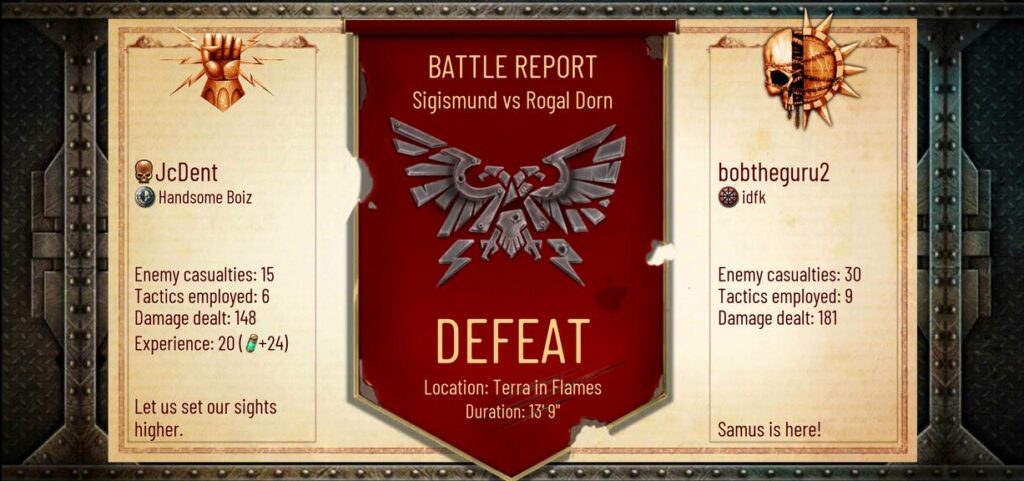
So while Dark Angels could boost a 1 attack unit to actually 4 attack or more, you could still attack and kill it. Meanwhile, a shitty Imperial Fist turret could have 0 attack normally, but with Sentry 3, it would deal three damage to the attacking unit before that unit was able to deal damage.
When Rogal Dorn got transfigured, he’d give blanket Sentry 3 to all units on his side.
I’m sure Horus Heresy: Legions was on the way out before the Imperial Fist re-release, but I choose to believe that it was the last straw. After that update, on March 18, the game when into a stupor basically. Looking at the news, any meta or balance updates stop.
On May 22, it was announced that Horus Heresy: Legions would shut down on August 31st.
It’s understandable — I doubt the game was doin’ noimbaz. Looking at the Steam charts (the game started on mobile and was eventually released on Steam), the player count slowly rose to February 2023, when the release of Shadow brought in record 685. Afterwards, it was a steady drop, followed by a God-damn plunge in May 2026 (though IF release itself, after an understandable peak, wiped like a 5th of the player base).
The Story Of Horus Heresy Is The Story Of Me
It’s still a shame! Horus Heresy: Legions had played a outsized part in my life — or, at the very least, consumed an outsized amount of time. I had played it basically every day since I got into beta some eight years ago. My early review was reshared by the devs, probably because I was one of the few people writing about it.
I played so much Legions over the years, I had to set a timer on my phone, limiting me to 30 minutes a day. And I don’t even like CCGs — they’re too abstract, too gamey for me.
But Horus Heresy: Legions was the one good Horus Heresy game. On the phone, it was the one good game with Space Marines. For whatever respect I have for Space Wolf, Legions just hit better. Legions made me want to play more tabletop, which was never exactly a good game even when it was helmed by people who knew what they were doing (Alan Bligh).
The art from Collected Visions was a bit goofy, but also had a lot of charm. The Warlords had six voice lines to be used (and, by some people, abused) at will. Dark Angels got some unreasonably cool lines and deliveries, like Farith Redloss’ “The glass turns. The grains fall” and “the moons are crying.”
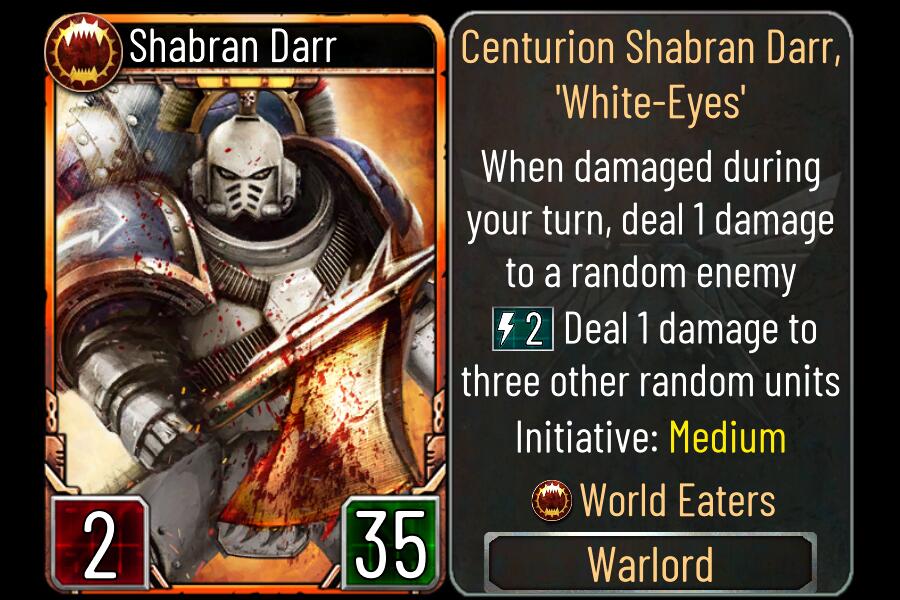
My boy Shabran Darr would just open with “all I feel now is cold hate” and I loved it every time.
Sometimes, when warlords with long history in the setting faced off, they would have unique greeting lines (some were better than others — and my boy Raldoron 1.0 did not have it good).
You could bind your avatar, card back, portrait and quote to specific decks, and I absolutely did as some sort of roleplay.
I even dropped money on this free to play game to get sick cosmetics.
Naturally, this stuff made it easier to get attached to certain Warlords more than the others. On my 30K chat, I became the one guy known for carrying the torch of Shabran Darr, ‘White-Eyes’, a World Eater loyalist of little renown who died on Isstvan.
Falling in Love With the Blood Angels
Naturally, the other half of any relationship was gameplay. And apparently, I had a thing for Warlords that made the enemy regret having any surviving units with one HP. And nobody was better at it than Raldoron 1.0.
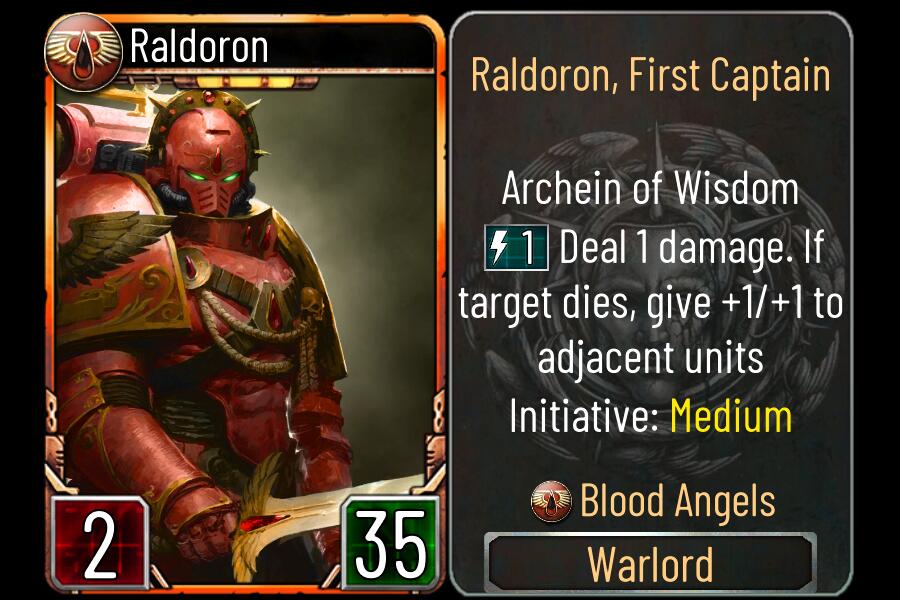
He had a very simple ability: deal one damage; if the target dies, give +1/+1 to units next to the warlord. So, congrats! Your beatstick that survived on 1 HP is not only trivial to deal with, but it will now also boost my own forces. You idiot. You buffoon.
All in all, my Legacy Raldoron deck was heavy on drop pod (read: ablative HP that only works on the turn the unit deployed) related fuckery. I could increase the drop pod health. I had a card that would give a unit Flank (act on the turn it was deployed, but not for attacking the enemy Warlord).
This was crucial, as one of the two Blood Angel gimmicks was Landing: effects that would trigger if the drop-pod protection went away by itself (rather than from enemy damage). That would normally happen when the unit activated on the next turn after deployment, but Flank let it activate immediately.
There was a 6/6 Legendary Moritat that would destroy the enemy unit with highest health while Landing. Deploying him made for a perfect fire magnet as the enemy scrambled to strip away the drop pod. Deploying him and then giving him Flank made the enemy lose their strongest trooper and whacked another with a 6 attack.
There was also a Stealth-stripping card that deal 1 damage to all enemies and drew cards for every that died.
With Host of Angels, I could deploy three Clonatus squads — piddly at 2/2, but if they didn’t lose their drop pods, they’d jump to 4/3…
And, of course, Spear of Telesto, which would hopefully be charged by deaths of friendly troops to the point where I could BLOOP some enemy combat monsters at the start of my turn for zero energy. Did it always feel good? Yes. Did I save that card to play last in turn, after I had spent all my energy already to taunt the enemy? I can’t say that it never happened.
If the enemy blanketed his side of the table with trash, there was never a sweeter feeling that hitting it with the 8-energy Legendary Crimson Spectre — not only is four damage per unit somewhat solid, but each kill also heals my Warlord for two HP. Few cards had such amazing turnaround potential — bordering on griefing, considering that you could not only wipe the enemy field, but also restore 33% of your Warlord’s (Raldoron had 35) health.
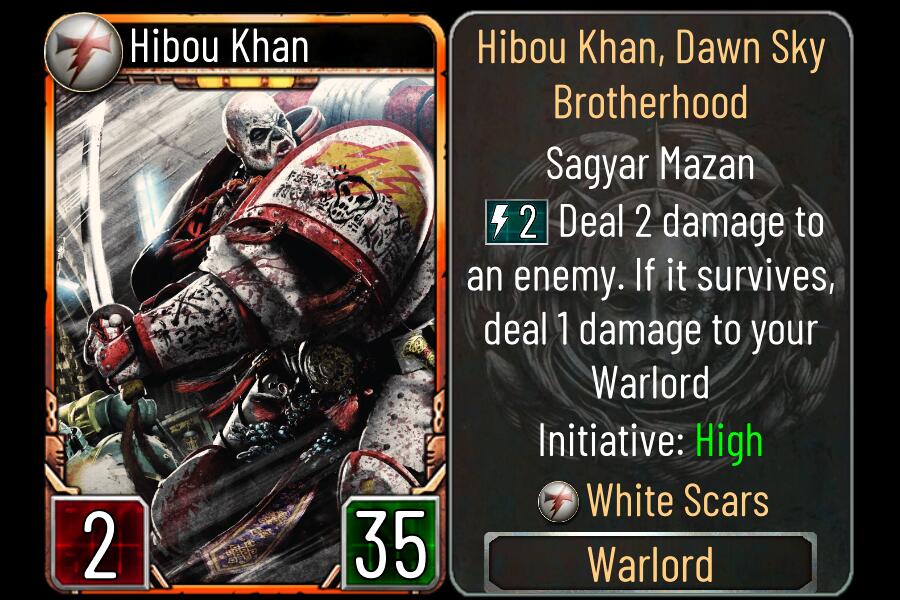
The biggest downside to Raldoron was his art: he was almost certainly based on the generic Blood Angels Praetor, and thus not very inspiring. To me, Shabran Darr and Tarik Torgaddon, while generic, looked better, and the likes of Hibou Khan and Nassir Amit were really great.
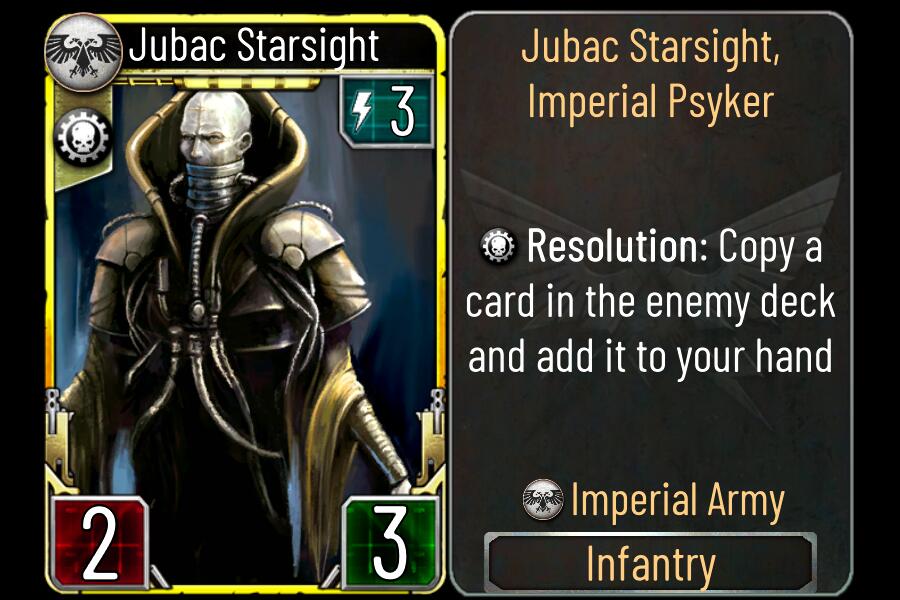
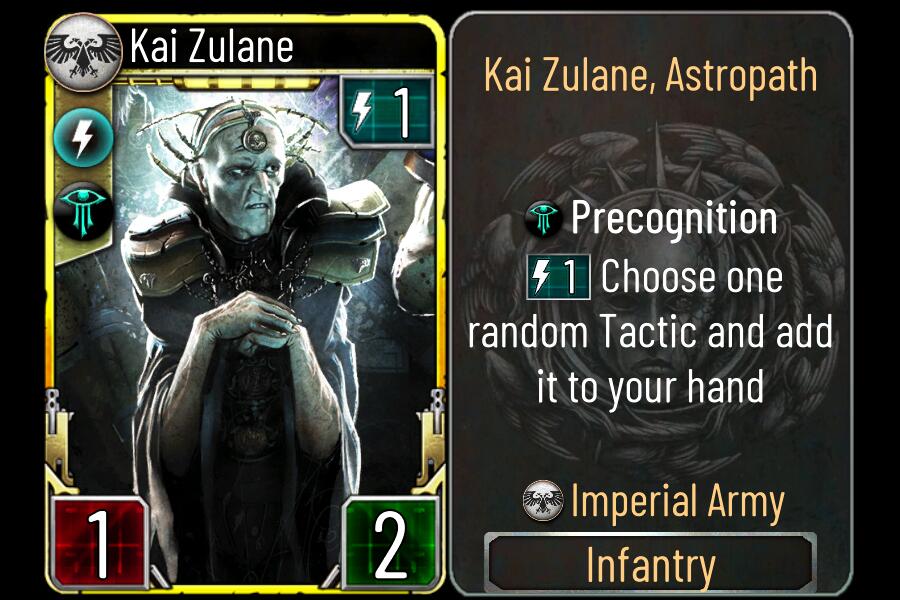
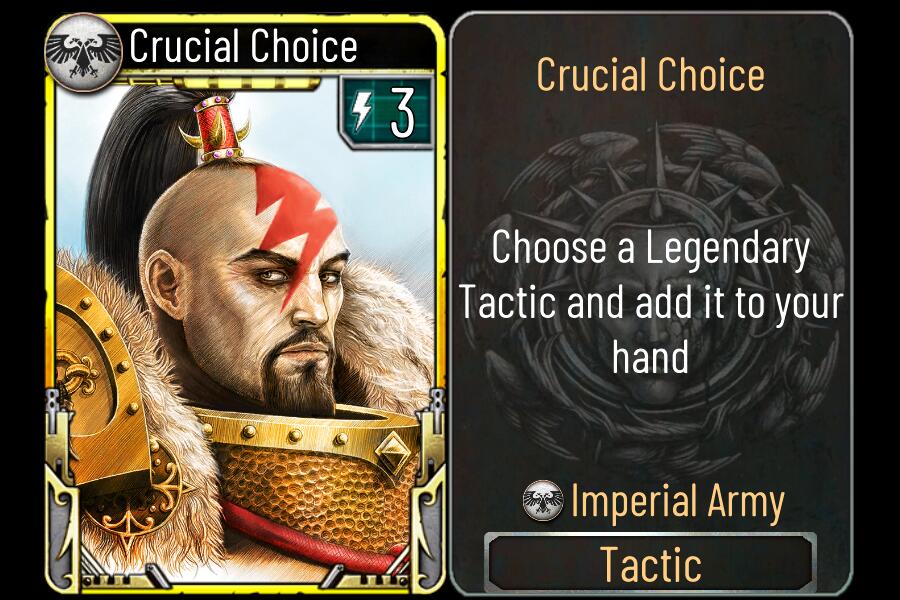
But there’s another kind of fun fuckery that marked the Legacy era that mostly went away with the transition: getting cards you weren’t supposed to have. Jubac Starsight, Kai Zulane, Crucial Choice, Mount Pharos were only the most prominent ways to get something – potentially legendary something – that should have never been possible to get in your deck.
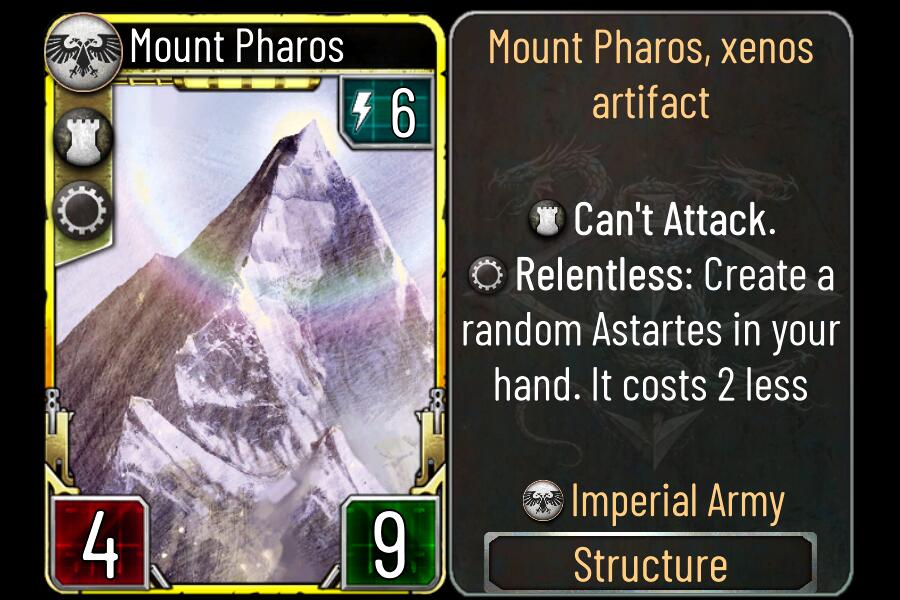
This, however, became an increasingly dicey proposition as the game developed: factions like Knights, Titans, Maelstorm Demons (a faction that thankfully got axed entirely) and Thousand Sons had plenty of cards that were absolutely unusable to others. As as gimmicks started becoming more entrenched and vital, their share of cards increased as well.
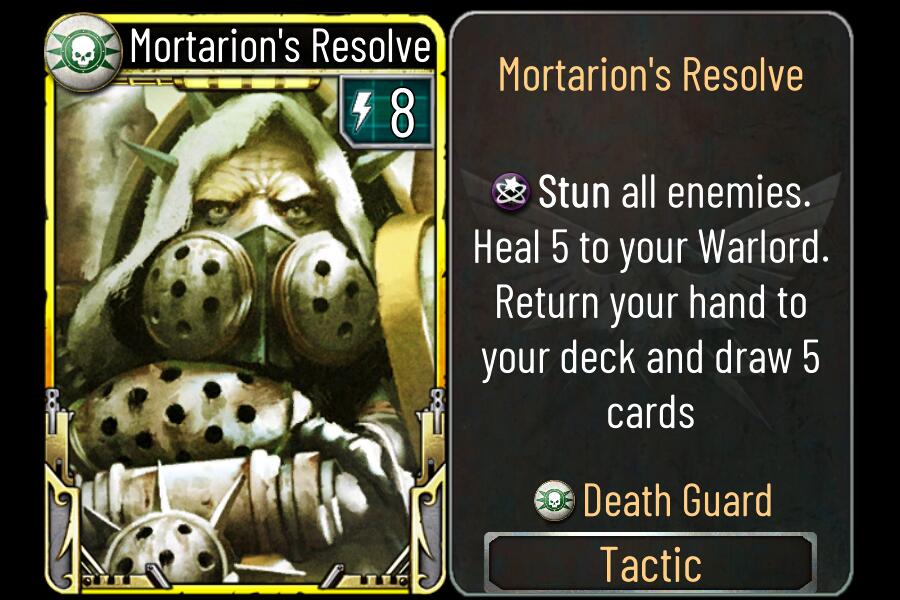
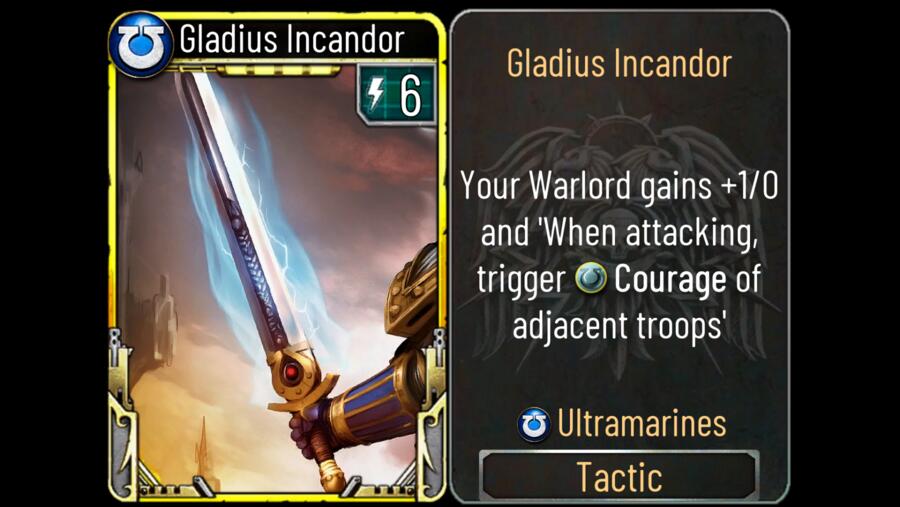
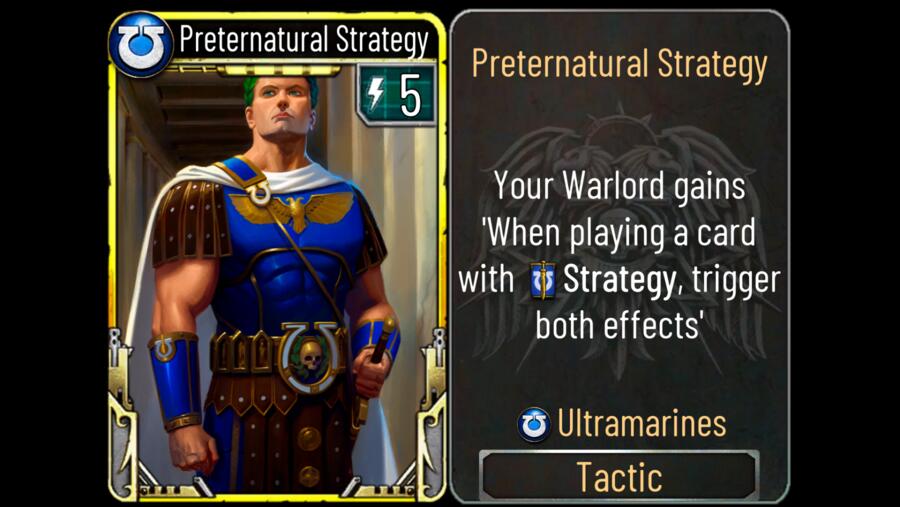
Something like Vengeful Spirit or Mortarion’s Resolve could be useful to basically anyone. Gladius Incandor and Preternatural Strategy could be useless even to an Ultramarine deck.
Now, as I mentioned before, I was never part of the game’s community. I rarely am. But Legions is unique, somewhat, in how many people I knew (even if online) at least tried to play it. I even had a multiplayer match with a guy in the same room once.
However, one by one, all of those people drifted away long before the Shadow of the Warmaster update was announced . I don’t know what drove them away. Some definitely could get their fix of Horus Heresy somewhere else: my 30K community was fairly happily playing the miniature game since the dark days of Tom Kirby (none of them could have been prepared for the way 3E would kill their enthusiasm). Others may not have felt the same sickly need to play Space Marines.
But by the time the closure of the game was announced, I had been the only person I knew still left playing Legions. I was the one guy my 30K community pointed at as still playing Legions. So something may have been rotten at the heart of the game.
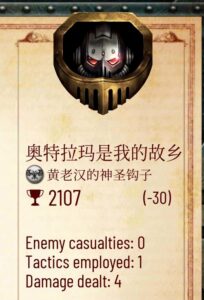
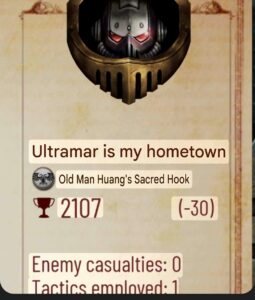
At least the Chinese fans were having fun:
We Lost the Knowledge of Making a Good Horus Heresy Game
Not for me, however. There are only two other 30K games that I know of or remember. Drop Assault was so insulting as a Clash of Clans clone that I felt flu-like symptoms after trying to give it a second chance. Meanwhile, the Talisman edition of Horus Heresy is — well, it’s still Talisman, a transitional game for those who have outgrown Snakes and Ladders, but find Monopoly intimidating.
Meanwhile, Horus Heresy: Legions hit all the sweet spots. The abstraction of combat, something that drives me away from CCGs, probably helped: you can’t get pissed at depictions of combat if there are none. I’m entirely too milhist brained and everyone, from people working on Horus Heresy rules to Black Library writers, operate with the understanding that a Hollywood melee moshpit is the height of warfare. CCGs spared me from that.
Furthermore, as someone who had played since beta, I had no issues with card availability. As someone who had no CCG experience, I couldn’t criticize the mechanics too much.
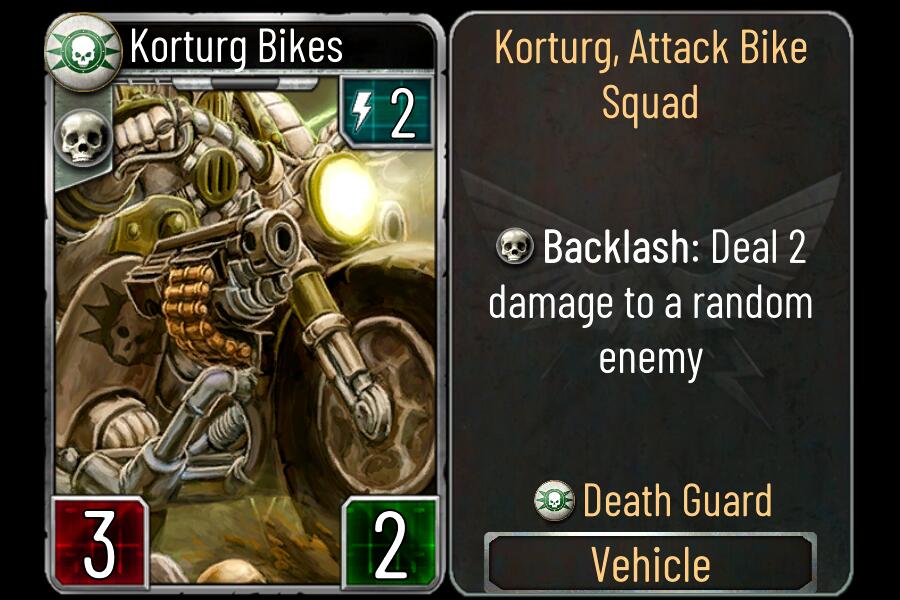
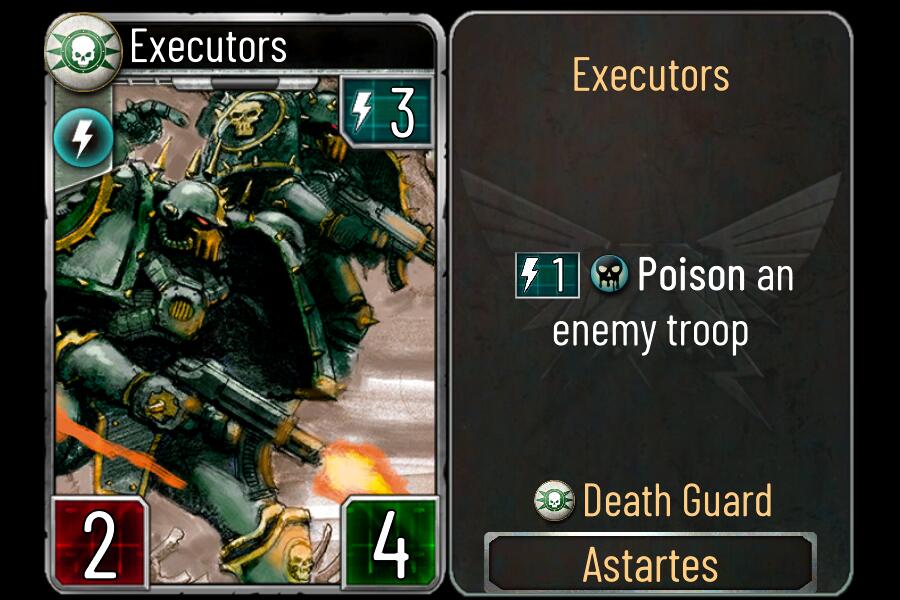
And for the longest time, the Horus Heresy Visions art was weird and wonderful. It wasn’t ripped entirely from existing SKUs and it lead me to custom build some Death Guard bikes. I still have, unfinished, the Death Guard Legion Seekers that will be in black in tribute to the Executors.
A lot of the time, playing a deck from a different Legion meant that my mind was invaded by that most perilous of thoughts: I should collect [Legion]. If I finally end up going with my Epic 30K project, I’m most likely going to be making Blood Angels and it will be the result of me playing that much Legions.
Game Good
At the end, what else is there to say? I had fun. And as the end neared, maybe even before the announcement, I turned, probably for the first time, to the Legacy mode. I got to take out my Raldoron deck — never deleted, unlike nearly all others — to play. And I played, and I had a blast! Seeing old cards against wasn’t exactly like seeing an old friend, but it was comfortable. Nostalgic, maybe.
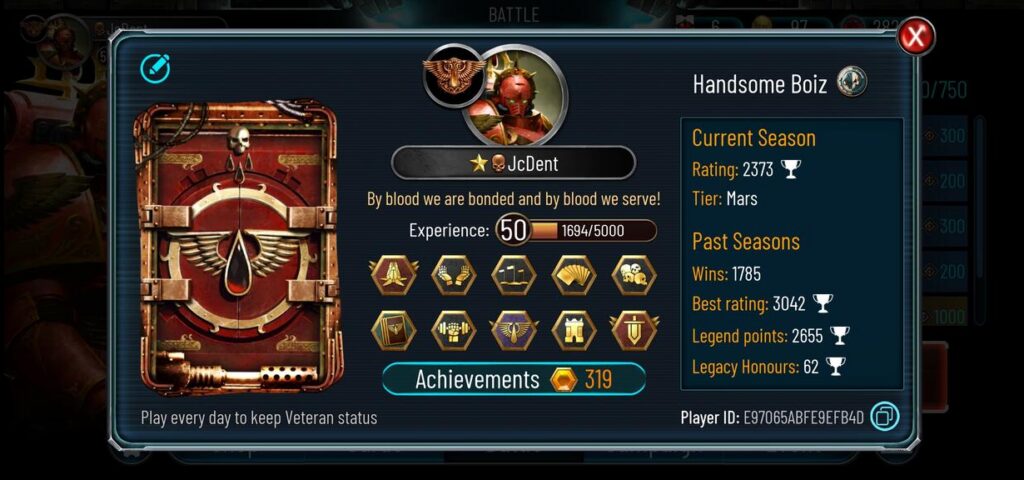
I got to play with Shabran Darr again. I even took the chance to play with Path of Heavens’ top character, Ravash Cario. Unfortunately, I didn’t get my hand on Magnificum Incendius, but what can you do, Titans are trash and the drop rates on legendary cards were always around one per 25 boxes for me, online statements about official drop rates be damned.
I have had my time to experience something close to mourning and say goodbye to the game. This is the closest I ever got to what communities did as their beloved MMORPGs came to an end. I had several months of bittersweet nostalgic gaming. And I will find a way to fill those thirty minutes of the day now bereft of Legion.