
Through the grace of Slitherine’s marketing department, I have, over the years, collected all the modern Combat Mission titles and their multiple expansions for free. Yet I haven’t reviewed a single game. Why? Because I never felt I like had played enough of anys single title to have an authoritative say about it. However! The games are very similar, running as they are on a single engine. With that in mind, I might just get away with reviewing all of them – the whole modern Combat Mission catalogue – with a single blog post.
What is Combat Mission?
Combat Mission is a long running series of turn-based wargames, where you can command a force the size of anywhere between a reduced platoon to a battalion (possibly more).
What you control, however, are infantry squads (which can be broken down into teams), teams (sometimes as small as two snipers or a lonesome Soviet platoon commander) and individual vehicles. Your troops have their training and morale levels, ammo counts tracked down to individual bullet and grenade, and, in the modern titles, equipment like NVGs.
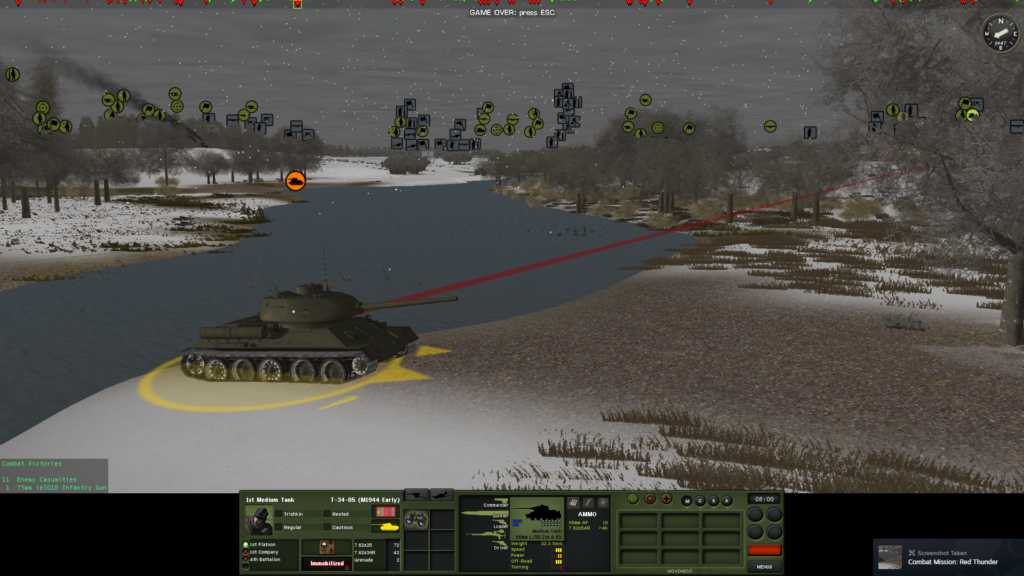
Meanwhile, the vehicles come with simulated armor, subsystems to be disabled, crew members that can fall to harm, and so on. Heavy artillery and anything flight capable exist as call-ins and are only rendered in your imagination.
Most Combat Mission titles are about World War 2, though several titles set in hypothetical modern conflicts exist as well. Those would be Shock Force 2 (a NATO invasion of Assadist Syria), Black Sea (a then-hypothetical war in Ukraine, but with the naive assumption that US would get involved on the ground), and Cold War (Cold War going hot in the 1980s).
It is interesting that none of the post World War 2 titles cover any actual wars. It’s not like games can’t support scenarios with less than platoon of troops per side.
The one title set in an actual Cold War conflict – Afghanistan – was produced by a third party studio ages ago and never updated. The only other real attempt at modeling asymmetric forces was made in Shock Force, with mixed results. I’m sure trying to make the Combat Mission model insurgents trying to blend in the population required some black magic.
Plus, here’s something I learned after having finished the first draft. As cool Combat Mission and military history YouTuber Usually Hapless described in the video on his ascension to Maker Of Actual Combat Mission DLC, small forces can quickly fall to random factors entirely out of player control – trying to cook up something representative of guerrilla warfare in the game engine is, at best, arduous.
But back to the game play. Under normal circumstances, Combat Mission is about chaining unit orders and hoping for the best. The troopers will instantly jump to carry out your commands based on their morale, suppression level, and the whims of LoS/pathfinding.
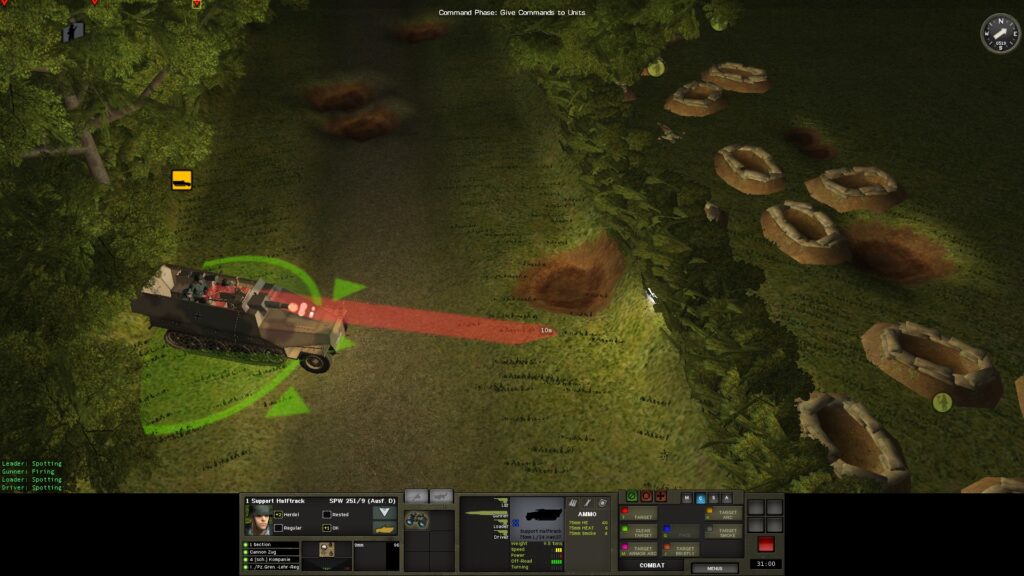
While the order types can get as granular as telling the unit to deploy their crew-serced weapons or for tanks to unbutton, most of your bread and butter is in movement. There are five basic movement commands, all balancing speed, stamina, spotting ability and the way troops react to the enemy. Large frontline squads also have Assault, which is meant to make the unit do bounding overwatch, but largely only gets it killed.
You do have various fire orders (for both setting fire priority and lighting up any bushes you suspect having Nazi sympathies), but most of them only kick in at the destination of a movement order, not during. Of almost greater import are fire arcs which, counter-intuitively, mostly get used to prevent units from firing when scouting.
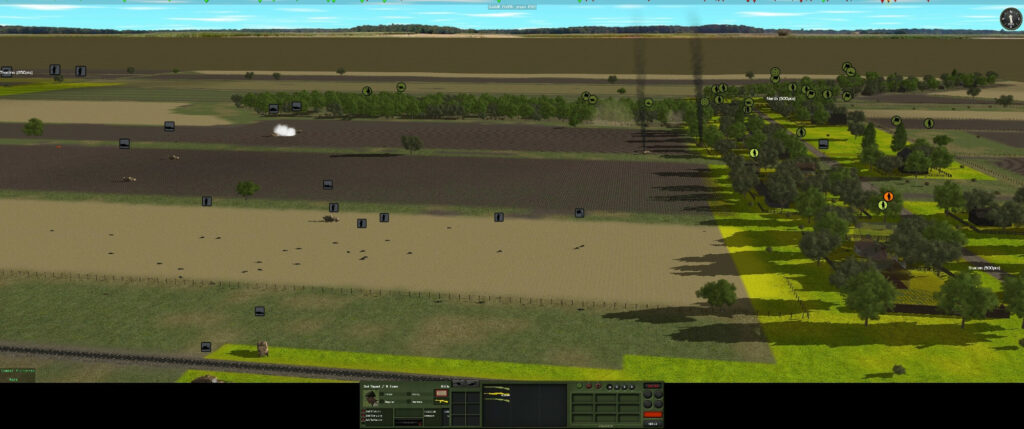
You may not see in the screenshots, but the game maps are actually comprised of a grid of squares, at least for control purposes. So it’s not free-form RTS movement – you can order a unit to a square, but what its final formation will be depends on terrain and whatever tactical AI is feeling like doing. Squares only really exist to annoy the player and map designers.
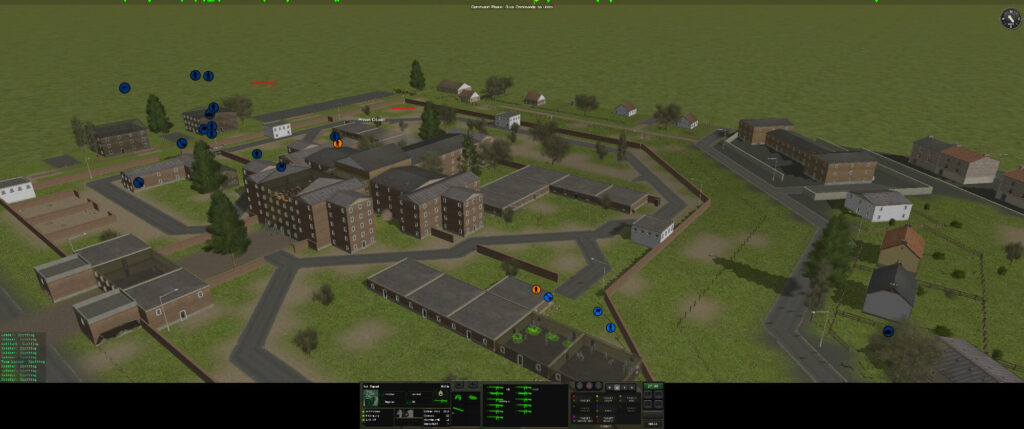
Buildings are kind of free of such systems: each building floor is treated as big empty room, but windows and doors that are mercilessly WYSIWYG. Really large buildings can have several rooms per floor – I assume that’s via magic of actually being several smaller buildings in disguise.
Choosing the best ways to play war
Sharing the same engine, the Combat Mission titles play roughly the same, with the major differences stemming from the forces and the period involved. If you know your history, you won’t expect the Wehrmacht that fought in Normandy to be exactly the same as the Wehrmacht getting rolled during Bagration – or defending in Germany itself. So it makes sense that there are differences between the units composition, cost, and rarity in Combat Mission: Normandy, Combat Mission: Red Thunder and Combat Mission: Final Blitzkrieg.
The most amusing time skip exists fully within the bounds of a single title. Cold War contains forces – and at least a single campaign – that have 1982 and 1985 versions, to reflect the tipping point after which the NATO technological superiority decisively outweighted Soviet numbers.
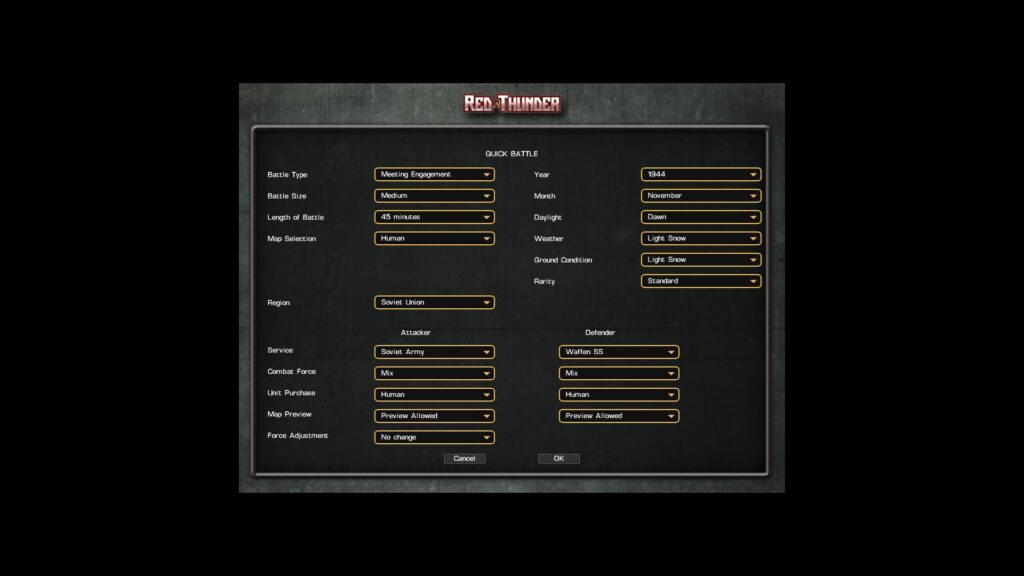
So, once you have your choice of title booted, you have several play options: single player scenarios (can also be played online), campaigns (can’t be played online) or quick battles (you better be playing them online). The latter is what other games would refer to as „skirmish“ – you can choose your maps and forces freely. For the other modes, your forces are pre-built, maps and objectives pre-set.
I’ll be level with you here: quick battles are kind of garbage. The titles never provide any guidance on what map size fits what point value, so it’s very easy to take a force too large for the map. When building your force, your options are basically:
1) Take a battalion and winnow it down to the force of your fitting your points levels.
2) Add individual teams and vehicles.
You can’t pre-load troops into transports here either (EDIT: troops with organic transport start in it), which is as annoying in Combat Mission as it was in the ancient winSPMBT.
All your forces start already on the map, cramped in the too-small deployment zones. This makes arranging the forces probably the longest single part of any battle – and necessitating gentleman’s agreement to not just immediately drop artillery on the enemy deployment.
Dragging the units around is clunky and buggy, and trying to construct a linked trench line is basically not worth the effort. Which is as shame, going for probe/assault scenario makes for more interesting games as one side gets the point advantage while the other gets to deploy prepared positions (with another gentlemanly agreement to not put mines at the end of bridges – units will not enter detected minefields and only engineers can clear them).
Oh, and you can only pre-arrange for artillery to drop at a fifteen-minute delay at most, which is an absolute pain when you consider call-in times for some of the more exotic pieces. Things like missile artillery and naval bombardments have prohibitively long call in times, meaning that you have to put an FO in position fifteen minutes in advance.
Off-table reserves and things only becoming available as the games goes are for scenarios only.
Warts intensify
The real sin of the single player modes in Combat Mission is that, at the end of the day, the games strategic AI, which controls the forces – as opposed to Tactical AI, which controls the behavior of actual soldiers – isn’t great. It is actually so incapable that people making custom maps (God bless their martyr-like efforts) have to hand-craft instructions for it.
Not that surprising when Combat Mission requires that much game mastery in addition to tactical skill, but with so much experience with the engine, you’d think the team would be able to do better.
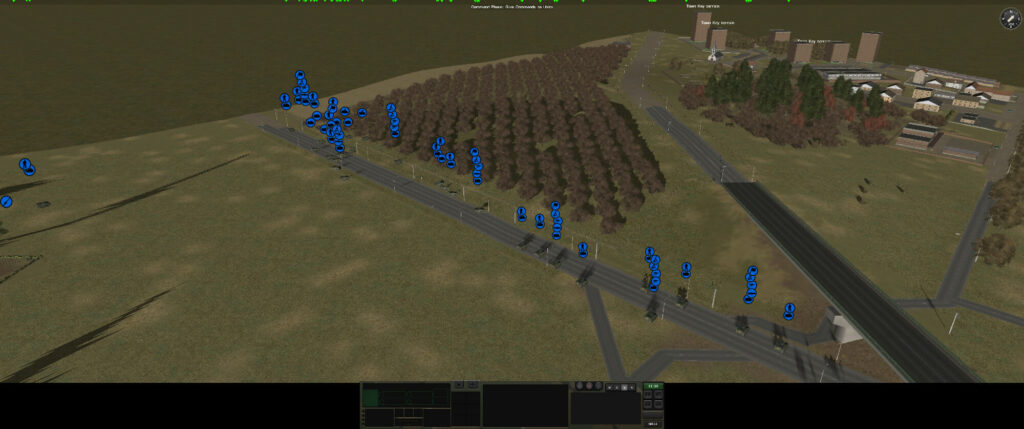
Oh, and there’s also the fact that the developers remain unaware of the fact that map sizes in the game are just too small to fascilitate modern warfare. I’ve seen Something Awful goon games of Black Sea go awry because Abramses were shooting T-90s, deployment zone to deployment zone. I had my own games of Shock Force 2 go bad because the other player brought top-of-the-line T-72s to snipe my own deploying troops.
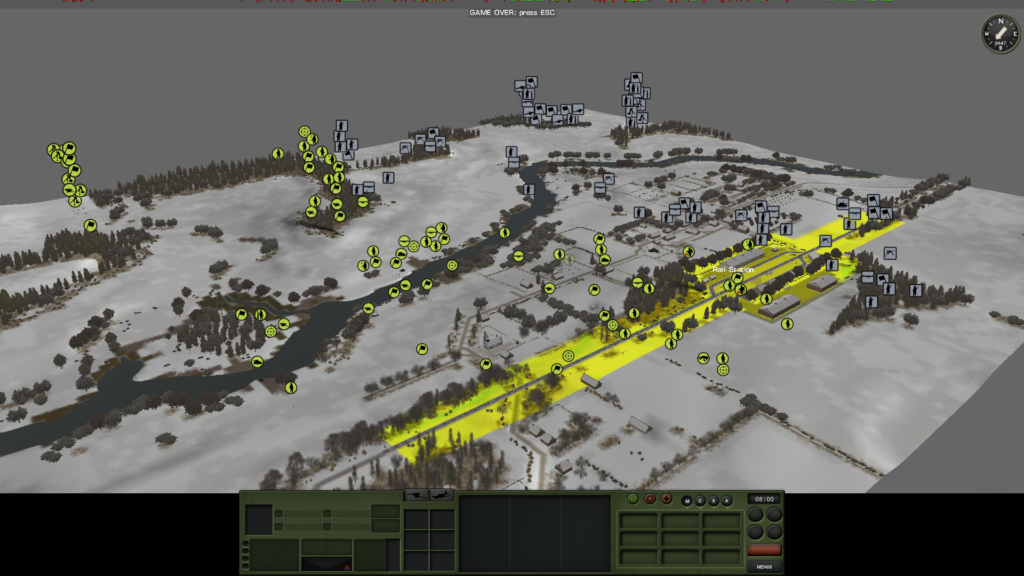
But increasing map sizes is hardly an option. One reason why I dropped the American campaign in Cold War is that, by the third or fourth mission, you’re dropped into a map that makes even the most modern PC chug. And let me spoil you the review a little: Combat Mission is not the most visually-impressive series of all time, probably never were, so the performance issues must hide somewhere deep in legacy code.
Campaigns and scenarios are much more fun. Sure, you still run into the issue of strategic AI being dumb, limiting replayability. But you can’t build your forces (incidentally also limiting shenanigans, like Multiple Small Unit spam with Syria’s famous crack inghimasi engineer RPG teams), and whatever units you may have will likely arrive in staggered deployment. Mission objectives may be more creative than just holding a random patch of ground, though any scenario developer trying to do so is probably working against a recalcitrant engine.
You also get to enjoy some pour soul’s efforts to create defensive emplacements so you wouldn’t have to. That’s why scenarios are failry enjoyable on multiplayer – even if you’re playing two matches of the same scenario simultaneously to experience both sides at once, what another person will do with the same forces is hard to predict.
Salt is the god of wargaming reviews
Plus, in campaigns, the battle have context and you finally have a reason to have units sit in place and take care of the casualties – normally (and from observing many a Usually Hapless video), there’s really no reason to do that outside of picking up special weapons.
Sadly, there’s not much more you can do to get down and dirty managing your persistent forces as Combat Mission is already struggling with concepts like „letting the player choose the next scenario in the campaign.“ In Cold War, this is carried out by:
1) Launching mission.
2) The player spawning with a single M113.
3) The player having to order the M113 to one of the two objectives to choose the scenario.
4) The player having to cease-fire the mission to have it end.
This is some „hey, we’re pushing what can be done with the WarCraft 3 map editor to the limits to produce the Defence of the Ancients mod“ stuff, but for people in full control of the source code in 2020s.
Wild!
But, as you may have gathered already, Combat Mission is just brimming with all sorts of jank, atavisms and weird design decisions. Do you want a game where you can control a battalion while also manually loading a US fire team into an M113 to then tell it to pick up some M72 Laws? Do you want to order artillery missions from batteries simulated with individual tubes and rounds, but with no way to know how long it will last or how many shells will be used?
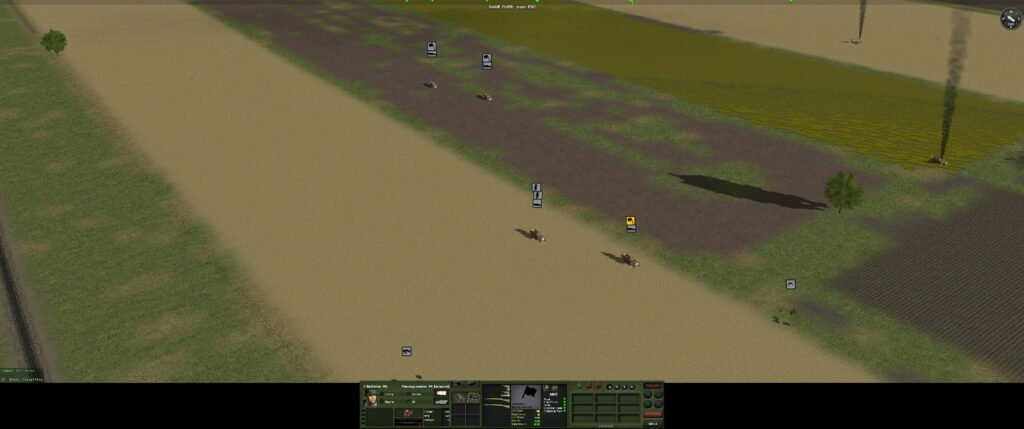
Do you want to have artillery observers incapable of creeping barrages because you can only give further orders to the FO or the battery after the current one is completed, incurring the full call-in delay? Do you want to be unable to tell infantry where to place smoke grenades unless you manually set unit facing before giving the smoke order as it just tosses the grenade in the direction that the unit is looking?
Do you want developers that very, very smug about how line of sight is simulated for every person in the field and then give you no tools to check it without either scrolling down to the eye level or playing with order tools and manual target commands? Is a function like that only fit for casual games for babies like Graviteam Tactics and Armored Brigade II?
Do you want star shells, flares, or Soviets having radios at all?
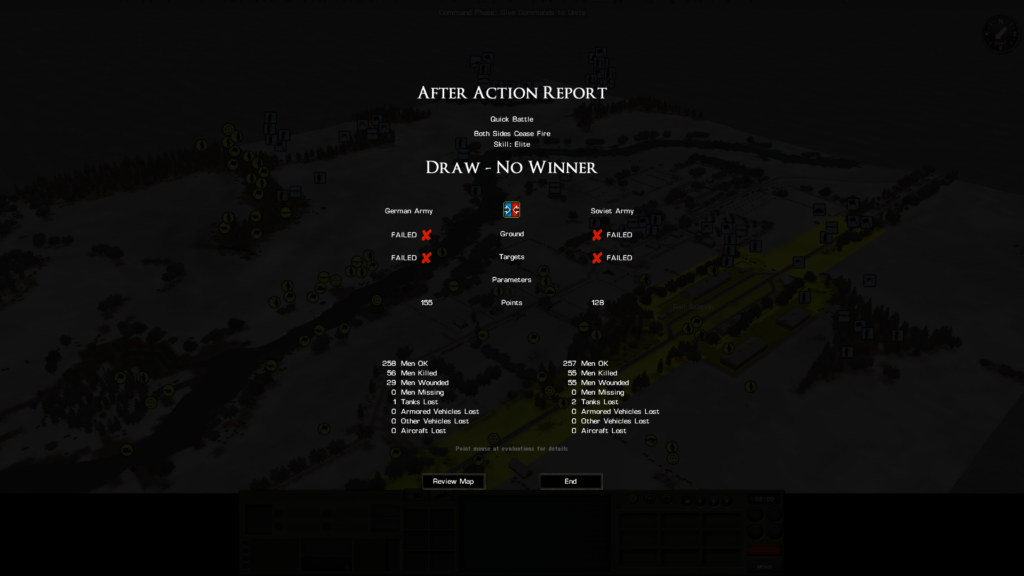
What else would like, you casual fuck? Interface pop-ups explaining what a button does? PBEM++ not eating the post-battle debriefing now and again?
I have 160+ hours in this series
I have realized, at least one and half page ago, that I should, at some point, explain why I keep playing – and will keep playing – Combat Mission.
I am currently running a Combat Mission: Final Blitzkrieg game with Cohost user Eagletanker while I wait for her to to get around the scenario editor on Combat Mission: Red Thunder to so we could continue the ersatz campaign she came up with. I have probably put more hours into CM titles than into Armored Brigade and Flashpoint Campaigns combined, and those series are much more pleasant to use and modern.

It’s just that nothing else really offers what Combat Mission does, especially at small scales. Men of War has this RPG-like level of granularity, but is otherwise as authentic or capable as depicting real combat as Red Alert 2 or Company of Heroes 2. Steel Division looks a lot better, handles large maps excellently, and features all the equipment (and not just tank all stars) but its gameplay is calibrated for the APM crowd (and is also as realistic as Red Alert 2).
Graviteam has flexible and easy artillery controls, tools for Line of Sight (down to showingwhich vision ports on a tank are currenly in use), fairly easy and in depth order system, but the interface is somehow worse than in Combat Mission.
But there’s a feature that’s almost if not more important than that: Combat Mission isn’t merely turn-based – it’s turn-based with simultaneous resolution. Which means that the game is paused while you give orders. Once you’re done, a minute of in-game action resolves, at which point you can give orders again. So, for at least a minute, the real time simulation runs without giving you any way to impact the events, obliviating reaction speed and APM as a concepts.
It also destroys various issues that traditional turn-based approaches have. Like, if one side gets to go first, they have the initiative to do things before the other side gets to react. You can try to resolve that by having players move one unit at a time or by adding ractions or splitting turns into phases, some of which allow enemy action (hello, Second Front). But none of those feel as good – plus, real-time action is a joy unto itself.
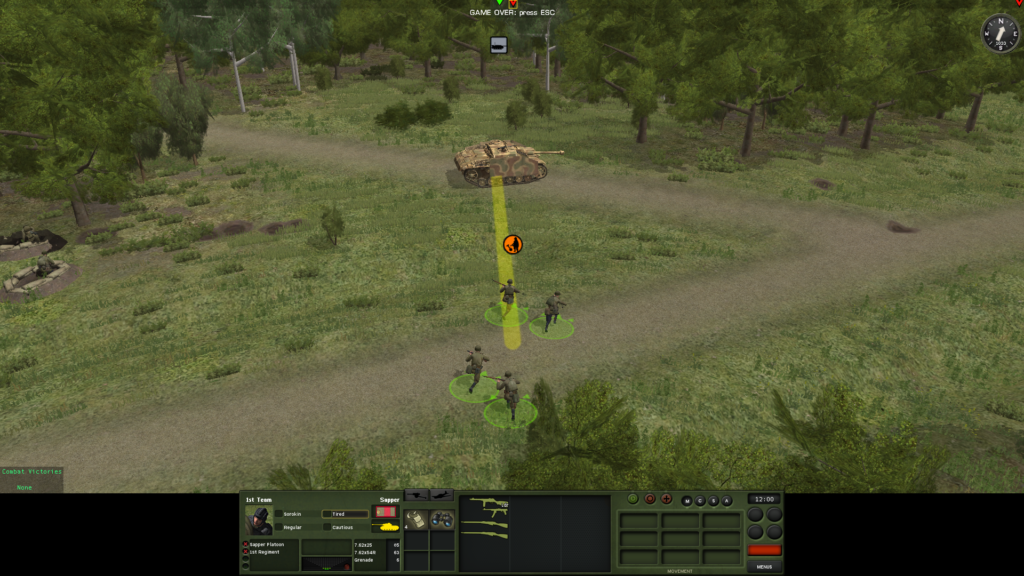
In turn based games, what your troopers do on the field can’t be that immersive/authentic due to the nature of the game. Unless they’re acting or being shot at, they’ll just stand there. And if they’re in a firefight, they’ll shoot as long as the shooting animation takes. RTS games allow for a much more verisimilitude, a natural flow of action… that you don’t have time to zoom in and observe, because RTS games are made for APM sickos.
None of those limits exist with simultaneous resolution. For your pixeltruppen, the fight never pauses – only the player is privy to the periods frozen time. As you give orders, you can observe mortar rounds hanging in the air. Once you commit orders, the world continues about like nothing happened. Meanwhile, you’re free to rewind and forward the simulation as much as you want, observing the action from any angle you please.
PBEM++ is douple-plus good
Yet this killer feature gets even killier in multiplayer. And not just any multiapler: Play-by-Email. I submit my turn, and Slitherine services (they have mercifully automated PBEM, so I don’t have to share saves by mail or a Google Drive folder) will send that turn to my buddy. Said buddy is then free to submit their turn at any time.
There is absolutely no need for us to be free and available to play at the same time. As an adult in Lithuania who has made friends all over the world, this is amazing. Very few games fascilitate that, and Combat Mission is the only one that does that at fun, granular level of individual infantry teams. My games of RimWorld and Divinity have stalled tens of hours in due to changes in life and lifestyle. Combat Mission with Eagletanker? Still going strong, as we both submit turns whenever we can.
Only series is better at turn-based simultaneous resolution – Flashpoint Campaigns has asymetric, variable length turns – but it lacks the pleasure of zooming in to look at your pixeltruppen mill about.
Also, Flashpoint Campaign has order delays! They’re based on electronic warfare, unit states, proximity to command elements, etc.. Conversely, I still don’t know what the purpose of command units in Combat Mission is outside of being the poor man’s forward obs- OK, enough of that!
Time for combat reform (without Mike Sparks)
Quite a few of the quirks that drag Combat Mission down can be laid at the feet of grog developers, who definitely do not have their ducks in a line. Like I said, they are entirely too proud of their LoS, which is a pain in the ass to adjudicate as a player, necessitating getting down to the soldier level – funnily enough, Graviteam faces a similar issue.
The series’ absolute hostility to any sort of quality of life improvements is, I believe, an combination of:
- grog designer priorities: as mentioned, they seem to care a lot more about putting out more content than making it more playable (unlike Flashpoint Campaigns);
- grog audiences: AAA gaming doesn’t give a shit about making serious historical titles, so people who are into that have been molded to accept visuals, audio, UI, etc.. fit for 1995, anything more being pie in the sky dreams for unserious people – consequently, no improvements will be asked for as long as the players get to order some Panthers into Bastogne;
- military college business: Combat Mission Professional Edition is used by militaries, and those care more about editable databeses than UX;
- job security: allegedly, the engine is the hands of one graybeard coder that has not documented it all.
In fact, anything that makes Combat Mission less painful to play is essentially the effect of Slitherine purchasing Battlefront and dragging them, kicking and screaming, to modernity (or, at the very least, 2008). Previously, the series weren’t even on Steam because selling the game on their own website let them keep 100% of the money (and reselling old games via engine updates must have been evern better).
That 100% of zero sales is still zero is logic that eluded them.
Battlefront’s website also sucked because 90% of these grog designers have the same attitude to web updates and UX as to quality of life and UI in games. In fact, I was probably not even 20 years-old when I was supposed to get a review copy of a Combat Mission title. The project died there as I encountered some website issue that prevented me from downloading the game I had already received the key for.
After Slitherine acquired the studio, the titles were promptly put on Steam, even receiving new DLCs and PBEM++ to fascilitate better multiplayer. This allowed me to put many, many hours into the games, both in single and multiplayer.
Mercifully, last year, Slitherine announced that there would be a new Combat Mission game, running on a new, clean sheet engine. Hopefully, this means that some thought will be put into making the game accessible to people who aren’t so milhist-brained that they will walk over hot coals to see DPCIM rain down on T-62s in Northrhein-Westphalen.I am too cautious to expect actual tutorials, but mayhaps interface popups?
Series Good?
So that’s Combat Mission. It’s one of the greatest military simulator series on the face of this Earth. It’s also one of the worst gaming experiences to get into, especially if you’re someone new to these games or, God forbid, are only mildly curious about military history. Fortunately, the winds of modernity seem to have breached the ossified walls of Battlefront studios. And who knows what welcome changes they may bring!